
Reed matting is stapled to the esb Plus lining. The base coat keys into the gaps between the reeds. In this wall detail, applying plaster “directly to esb Plus” means fixing the plaster carrier to the board. The mechanical connection is easy to miss once the wall is finished.
Inside the Eifel timber-frame house
A finished clay wall gives little away about the surface beneath it. In the timber-frame house in the Eifel featured in the elka and ClayTec brochure, a layer of reeds sits between the board and the plaster. A section through the wall shows how the first coat gets its grip.
Five layers, from board to room
The numbers follow the original section drawing, starting at the timber-frame lining and ending at the visible finish.
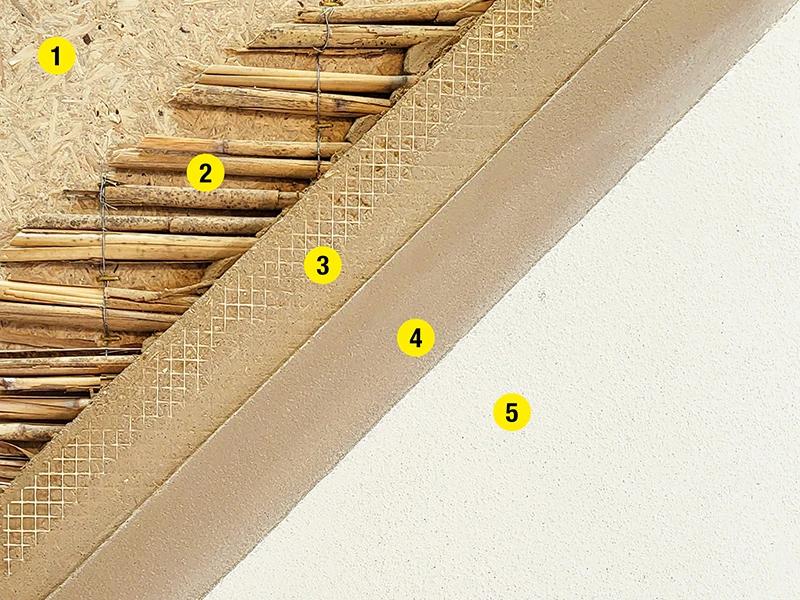
- esb Plus P5Tongue-and-groove board lines the timber frame and provides the fixing surface for the reed matting.
- St 70 reed mattingThe thicker continuous wire faces the room. For walls, the brochure specifies galvanised staples at least 16 mm long, spaced 50–70 mm apart.
- Clay base coat with strawGlass-fibre mesh is worked into the wet 12 mm coat. Adjacent strips overlap by about 100 mm.
- Fine clay topcoatOnce the base coat is completely dry, a 2–3 mm layer of ClayTec fine topcoat 06 provides the surface for decoration.
- Decorative finishThe illustrated wall has a 2 mm YOSIMA clay designer plaster finish. The brochure also gives clay paint as an alternative finish.
Why are two kinds of mesh needed?
The reed mat carries the plaster against the board. The glass-fibre mesh sits further towards the room, embedded in the base coat. Listing them separately in a specification makes clear which material needs mechanical fixings and which is worked into wet mortar.
When is the wall ready for the next coat?
Elka and ClayTec call for prompt, monitored drying of the base coat. The brochure gives no fixed waiting time in days. Allow time for drying and check the coat itself before applying the next layer. A representative trial area lets the team assess the substrate, application thickness and appearance together.
Documents for designers and installers
Clay plaster on timber walls: primer or reed mat? · Timber construction guides